We grow up hearing patriarchy of language in our communication on daily basis, like“Ye tu bohat sabir aurat hai (You are such a patient woman)”, “Achi aurat zuban nahi chalati (A good woman does not talk back)”, “Achi aurat ghar ki baat bahir nahi nikalti (A good woman does not reveal family matters outside the home)”, “khandani aur baqirdar aurat (A respectable woman from a respectable family)”, “Ghar bachana aur ghar ko jor k rakhna aurat ka kaam hai (It is a woman’s responsibility to save and hold the family together)”, “Zarur tum ne he shohar ko gussa dilaya ho ga tabhi tu us ka hath utha hy (You must have provoked your husband; that is why he hit you)”, “Aray achi aurtain apne khawand ki burae nahi karti, marta hy tu kia hua tum jawab nahi dia karo khamoshi se she lia karo (Good women do not speak ill of their husbands. So, what if he hits you? Do not answer back; endure it silently)”.
This patriarchal language may sound like ordinary cultural and traditional expressions, offered as piece of compliment or advice but in reality, these expressions reflect deeply rooted patriarchal systems. As patriarchy does not always announce itself through violence or direct discrimination. Sometimes, it speaks softly through advice, compliments, warnings, and moral judgments. It becomes a mechanism through which patriarchal norms are reproduced, legitimised, and passed from one generation to another.
A woman who never complains and silently fulfils all responsibilities with great care and love, and bear the weight of unpaid care work are often considered as good women/ khandani women. In Pakistan, women who try to fit themselves in imposed gendered family norms are always admirable. Her patience and sacrifices for families become her identity; her exhaustion becomes evidence of her goodness.
Patience and resilience are considered as admirable qualities of women. In Pakistan, women are praised mainly for tolerating mistreatment, suppressing their own needs, or carrying an unequal share of responsibility, endurance stops being a choice and becomes an obligation. Somewhere along the way, we learned to celebrate women’s capacity to endure instead of asking why so much is expected of them in the first place.
The double standard in our vocabulary
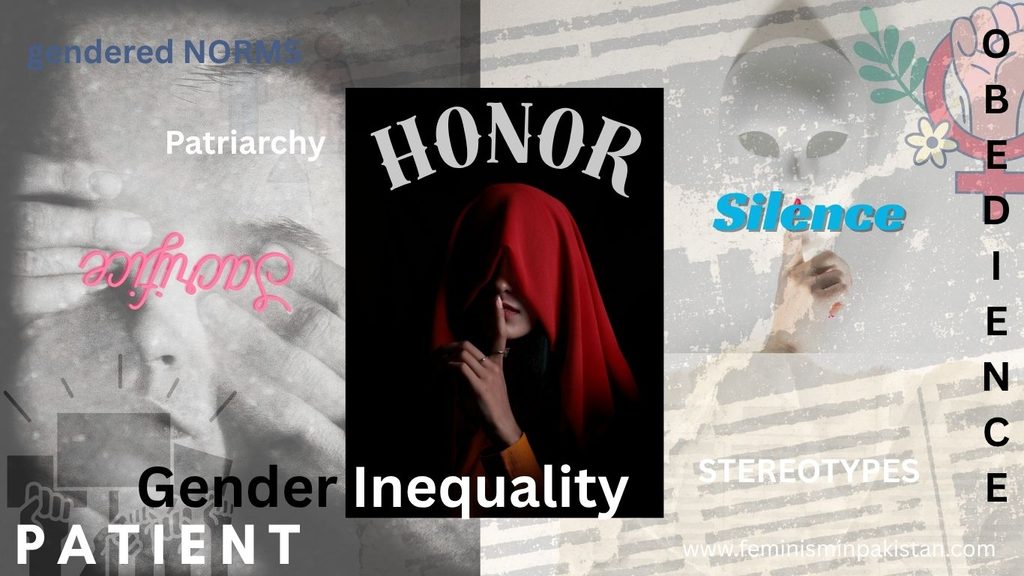
The inconsistency becomes clearer when we compare the words we use for similar behaviour in men and women. A woman who is vocal, know her rights and demand them is labelled as rude, vulgar, and difficult to handle or intolerable; Society labels a woman who maintains a routine, sets boundaries, or pursues her ambitions as aggressive and bossy, while it describes a man who displays the same qualities as ambitious, assertive, and principled.
The patriarchy of language is much common in our societies, a woman who maintains a routine or sets boundaries, and has ambition is considered as aggressive and bossy, when a man who follow the same traits is called as ambitious, assertive, and a man of principles. A man who has his opinion, is called a man and a woman who has her opinion, is called a bitch.
According to a Nigerian writer, Chimamanda Ngozi Adichie:
“We teach girls to shrink themselves, to make themselves smaller. We say to girls, ‘You can have ambition, but not too much. You should aim to be successful, but not too successful, otherwise, you would threaten the man.”
In our societies, the worth of man is measured by his conquests and a woman’s worth by her restraint, a man is considered logical and a woman is considered emotional, a man having multiple relationship is celebrated as manhood and woman are treated as slut or loose character.
The question is why the language is so biased in our patriarchal socities and has double standards against men and women . They are trapped in different gendered stereotypes, norms, and patriarchal language barriers, where men are starved to show their emotions. As a father, if he chooses to stay home and look after his children, he is praised as an amazing dad and when a mother does it, it’s just her baseline duty. Society often tells us that Men are from Mars and women are from Venus, as if our differences were natural, permanent, and impossible to overcome. But perhaps men and women are not from different planets; perhaps society simply raises them with different expectations.”
How language shapes expectations
Language does more than describe our perceptions; repeated labels and biased slogans and idioms used also reinforce them. When girls repeatedly hear that a good woman is one who adjusts, compromises and never says no, they may come to associate self-sacrifice with their worth. When we praise a woman only for her sacrifices, we risk turning self-neglect into a standard against which other women are measured. The woman who chooses differently may then appear selfish, careless or insufficiently devoted. Without intending to, we end up enforcing the very expectations that constrain us.
The same process also shapes the socialisation of boys, when boys grow up in these patriarchal environments, where authority, dominance, logic, and assertiveness are associated with masculinity, boys may internalise expectations of entitlement and learn to seek accommodation rather than practise mutual respect and reciprocity. Everyday social interactions normalise these gendered behaviours and pass them on to future generations.. The systematic separation of gender roles further reinforces unequal power relations, while the intergenerational transmission of these norms perpetuates patterns of discrimination, emotional harm and gender-based trauma. Consequently, gender inequality is not merely sustained through individual attitudes but is embedded in social structures, cultural practices and processes of intergenerational socialisation.
Changing how we speak
The problem is not that patience, resilience, sacrifice or care are undesirable qualities; rather, it is the unequal social expectations attached to them. When women’s endurance is celebrated without questioning the circumstances that make endurance necessary, praise and appreciation becomes another instrument through which patriarchy sustains itself. A woman’s worth should not be measured by her sacrifices for sustainability of the toxic patriarchal language and gender stereotypes. Tolerating such unjust and patriarchal language silently can make the situations worse. Similarly, men should not be confined to expectations of dominance, emotional restraint and authority. Gendered expectations and patriarchy of language shape women’s and men’s choices, relationships, and emotional well-being.
Challenging these deeply embedded norms and language partiarchies requires more than changing individual attitudes; it demands a transformation on broader level. There is need to bring change in language, institutions, family practices and cultural values, through which gender inequality are reproduced. We have to challenge the normalization of patriarchal language besides that we have to stop expecting sacrifices from them.
Gender equality cannot be achieved by simply empowering women to carry existing responsibilities more efficiently; it requires redistributing those responsibilities and questioning the patriarchal structures that make inequality appear natural. A woman’s goodness should not be determined by her capacity to endure, nor should a man’s masculinity depend on his capacity to dominate. We have to work collectively and raise awareness against such injustices and teach our future generations accordingly.
We need to challenge the cultural ideals of the self-sacrificing woman to strong women who establishes boundaries, expresses disagreement, pursues ambitions and refuses unreasonable demands.
Domestic responsibilities, childcare and emotional labour should be recognised as shared responsibilities rather than women’s natural obligations. Families and communities should encourage men to participate equally in household and caregiving activities..
Both, boys and girls, should be raised with values of empathy, mutual respect, emotional intelligence and shared responsibility. Parents, families, and educational institutions should raise boys and girls with values of empathy, mutual respect, emotional intelligence, and shared responsibility.
Assertiveness, ambition, emotional expression and leadership should be evaluated equally, regardless of gender. Men should not be confined to the expectations of being emotionally distant, dominant or financially authoritative. Creating space for men to express vulnerability, practise care and build reciprocal relationships can contribute to healthier families.
Women are mainly double burdened and they are engaged in reproductive and productive work. There unpaid domestic and care work must be acknowledged in social and economic policies. Institutions should promote accessible childcare, parental leave, workplace flexibility and social protection to reduce the unequal burden placed on women.