By Sameen Shakeel
Why do we question the choices of those who suffer the most? We victim blaming instead of holding accountable those who cause the suffering?
Here are some questiosns that are faced by women in our societies frequently:
What were you wearing?
Why were you there?
Why were you roaming alone?
Why didn’t you leave?
Why didn’t you speak up?
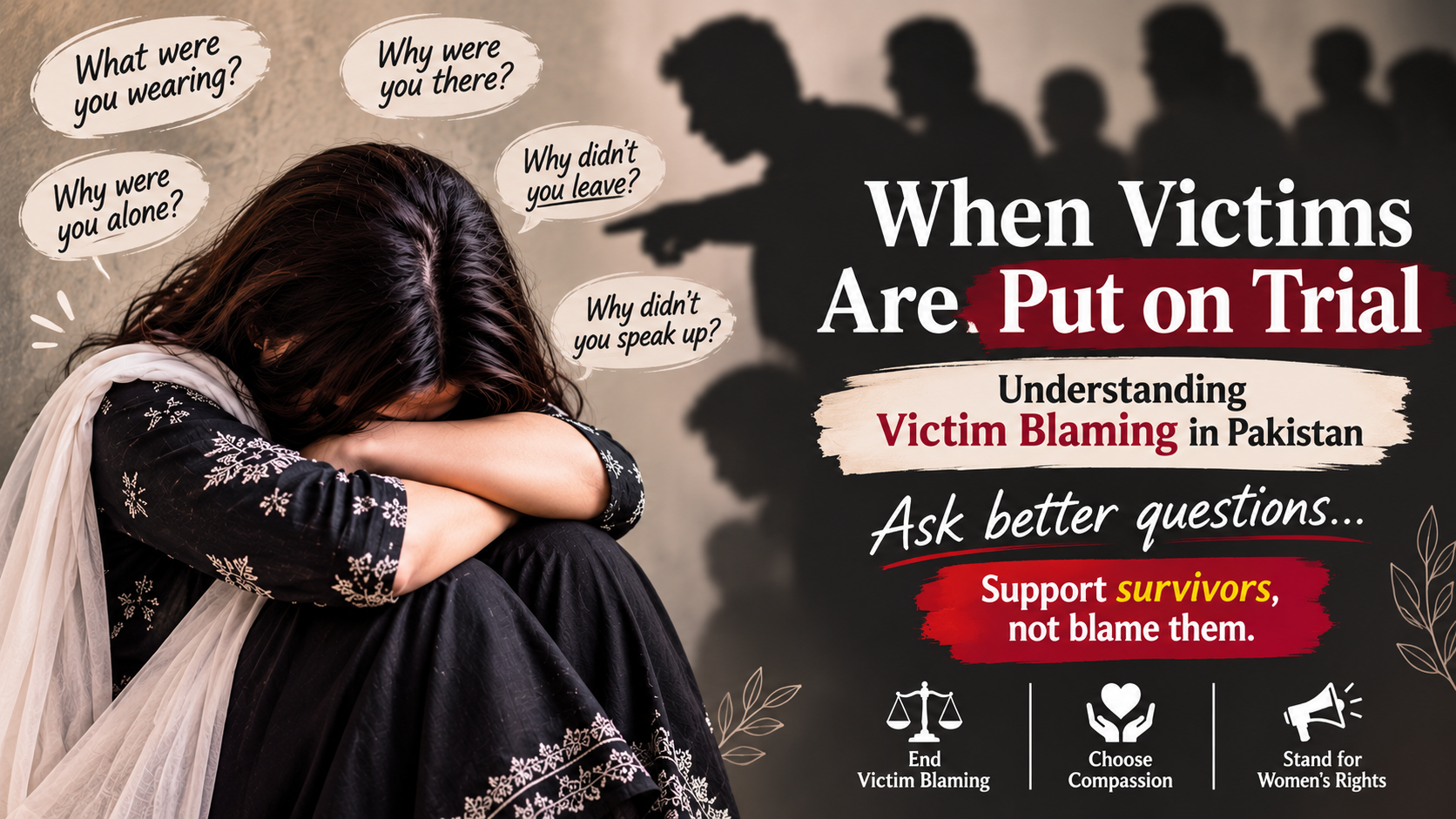
There are countless other victim blaming questions that are asked when women experiences harassment, abuse or violence. Yet the most important question is often the one we rarely ask the perpetrator: Why did you choose to cause harm to the victim?
Our society has perfected the art of blaming victims in different forms. Before offering comfort, we demand explanations. Before showing compassion, we question their decisions. And before acknowledging the harm they have experienced, we examine whether they behaved in a way that society considers acceptable.
We have created a culture in which victims are expected to do everything right to deserve sympathy. They must make the right decisions, recognise every warning sign, respond appropriately and behave exactly as society expects. When they fail to meet these expectations, their suffering becomes a subject of debate.
This is the troubling reality of victim blaming: survivors are made to justify their actions while the perpetrators responsible for their suffering fade into the background.
When the Victim Becomes the Accused
Victim blaming does not always take the form of direct accusations. It often appears through seemingly innocent questions, unsolicited advice or statements disguised as concern.
It happens when a woman reporting sexual harassment is questioned about her clothing rather than the behaviour of the person who harassed her. It happens when a survivor of domestic violence is advised to compromise, remain patient, be more understanding or protect the family’s reputation. It also happens when a child reporting inappropriate behaviour is dismissed, doubted or questioned instead of being heard and protected.
Although these situations differ, they share a common pattern: the person who experiences harm is expected to explain and defend themselves, while the person responsible for causing it receives less scrutiny.
Women are not secure in Pakitan, instead of providing security we question the victim; what she was wearing, their personal history, relationships, movements and decisions. We question why they did not speak up, why they stayed or why they did not leave earlier. Sometimes, survivors are even expected to prove that they did nothing to deserve what happened to them.
Yet somehow, the person who deliberately violated another person’s rights becomes the least questioned individual in the conversation.
Why Are We So Experts in Victim Blaming?
Victim blaming is often rooted in deeply held psychological beliefs, social conditioning and cultural expectations.
One possible explanation comes from the psychological concept known as the just-world hypothesis. It describes the tendency to believe that the world is fundamentally fair and that people generally get what they deserve.
When confronted with an unjust or traumatic event, some individuals find it difficult to accept that terrible things can happen to innocent people. Blaming the victim becomes a way of preserving their belief that the world is predictable and fair. They may convince themselves that the survivor must have made a mistake or behaved irresponsibly.
Another reason is the desire to feel safe. If people believe that a victim’s suffering resulted from poor decisions, they can reassure themselves that they would never experience the same situation because they would behave differently.
This creates an illusion of control. Instead of acknowledging that abuse and violence can happen to anyone, regardless of their choices, people distance themselves from the possibility of becoming vulnerable themselves.
Social conditioning also plays a significant role. In many societies, family reputation, traditional gender roles and family name are prioritised over individual safety and dignity. In Pakistan, this becomes particularly visible when survivors of sexual harassment, domestic abuse and exploitation fear being judged, humiliated or ostracised if they speak out. Instead of focusing on the violation of their rights, families and communities may become preoccupied with the perceived embarrassment the incident could bring to the family.
Questions about family reputation and honour become more important than questions about safety, justice and accountability. As a result, survivors may experience shame and isolation, making silence appear safer than seeking help.
The Cost of Asking the Wrong Questions
Victim blaming can have long lasting and traumatic mental and physical consequences. Being questioned, doubted or dismissed can make survivors feel ashamed, isolated and uncertain about their experiences. It can discourage them from seeking professional assistance, reporting abuse or reaching out to people who might otherwise support them.
Imagine gathering the courage to speak about an experience that has been painful and difficult to acknowledge, only to be met with questions about your own decisions. Instead of feeling supported, you begin to wonder whether anyone will believe you. You may even question whether you were somehow responsible for what happened.
This is one of the most damaging consequences of victim blaming: it shifts responsibility away from perpetrators and places an additional burden on those who have already experienced harm. It can also reinforce a culture of silence in which perpetrators face fewer social consequences because survivors are discouraged from speaking out.
We must also recognise that people respond to traumatic experiences differently. Some may speak immediately, while others may remain silent for months or years. Some may leave an abusive situation, while others may feel unable to do so because of financial dependence, threats, family pressure or concerns about their safety. Therefore silence does not mean consent, staying in abusive relation does not mean acceptance. And a person’s response to trauma should never be used as evidence that they deserved the harm inflicted upon them.
Our Little Acts Can Bring Major Changes
Creating a more compassionate and accountable society requires us to reconsider not only what we ask but also whom we hold responsible. Instead of asking, “Why didn’t you leave?”, ask, “What prevented you from leaving safely?”
Instead of asking, “Why didn’t they report it sooner?”, ask, “Did they have access to a safe and supportive reporting mechanism?”
Instead of asking, “What were they wearing?” or “Why were they alone?”, ask, “Why did someone believe they had the right to violate their dignity and safety?”
Most importantly, learn to listen without immediately judging, doubting or offering unsolicited advice.
Families must create safe and secure environments where survivors can speak without humiliation or fear of rejection. Educational institutions should teach consent, respect, personal boundaries and accountability. Communities must challenge harmful stereotypes and recognise that supporting someone does not require knowing every detail of their experience.
Institutions must also ensure that reporting mechanisms are accessible, confidential and sensitive to the needs of survivors.A compassionate society is not one that demands perfect behaviour from those who have suffered. It is one that recognises their dignity, protects their rights and holds those responsible for harm accountable.
We should never make anyone feel that they deserved to suffer. We should never turn a survivor’s experience into a courtroom in which they must defend their every decision.
Victims should not have to stand trial for the harm inflicted upon them. The real question is why someone believed they had the right to cause that harm in the first place.
About the Author
Sameen Shakeel is a Mass Communication student with a keen interest in journalism, content writing and storytelling. She is passionate about exploring social issues, examining inequalities and raising awareness through meaningful writing.