Esha Afzal | Feminism in Pakistan
Women’s Mobility and Everyday Safety in Pakistan
In Pakistan, women’s mobility to a university, workplace, market or hospital is part of everyday life. Yet travelling through public spaces can also involve concerns about personal safety. According to the Gallup Pakistan National Public Opinion Poll conducted from 6 to 11 November 2017, 24 per cent of urban women respondents reported having been followed by a man while walking to or near their home, office or a market. The same survey found that 51 per cent of female respondents had been deterred from using public transport because of the fear of
harassment. These figures are based on data collected in 2017 and should not be treated as a measure of present-day conditions. However, they illustrate how the fear of harassment can restrict women’s freedom of movement. Women travel for education, employment, healthcare and everyday responsibilities. When an ordinary journey becomes an experience marked by fear, access to these opportunities can be limited. Safe mobility is therefore not merely a matter of comfort or convenience; it is essential to women’s independence, equality and participation in public life.
1. Consequences of Street Harassment
Street harassment can include unwelcome comments, staring, whistling, gestures, following, honking and unwanted physical contact. Such behaviour may occur on streets, at bus stops, in markets and on public transport. Even a brief incident can have effects that last for hours, days or longer. A woman may avoid a particular road, stop using public transport, ask someone else to accompany her or take a longer route because she believes it is safer. In this way, harassment is not simply an isolated incident: it can shape how women use—and whether they feel able to access—public spaces.
These restrictions can affect women’s education, employment and access to essential services. A student may feel reluctant to travel to school or university; an employee may find it difficult to commute without assistance; and a woman may become dependent on another person for journeys she could otherwise make independently. Cities are designed around movement and access, but they cannot be equally accessible if women feel unsafe while navigating them. Streets, markets, parks and public transport should be spaces where women can travel without intimidation or discrimination.
2. Patriarchal Attitudes and the Normalisation of Harassment
Patriarchal attitudes can contribute to the restriction and control of women’s mobility. In some families and communities, women are told to avoid particular places, return home earlier or change their clothing, while the behaviour of those who harass them is not adequately challenged. This shifts responsibility from the perpetrator to the woman experiencing harassment. Such attitudes can also discourage women from reporting incidents. Some may remain silent because they fear being blamed, embarrassed, questioned about their clothing or dismissed by the authorities.
The normalisation of harassment creates another barrier to accountability. Behaviours such as staring, whistling, following and making unwanted gestures may be dismissed as jokes or harmless conduct. When these actions are minimised, it becomes more difficult to address harassment and hold perpetrators accountable. Women’s safety therefore depends not only on effective policing but also on changing social attitudes that tolerate, excuse or normalise harassment.
3. Legal Protections and Weak Reporting Mechanisms in Pakistan
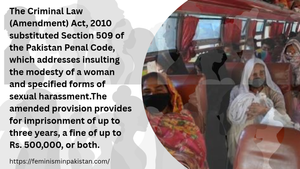
Pakistan’s legal framework includes provisions addressing certain forms of harassment. The Criminal Law (Amendment) Act, 2010 substituted Section 509 of the Pakistan Penal Code, which addresses insulting the modesty of a woman and specified forms of sexual harassment. The provision recognises that the conduct it covers may occur in public places—including markets, public transport, streets and parks—as well as in private settings. The amended provision provides for imprisonment of up to three years, a fine of up to Rs. 500,000, or both. The precise application of the law depends on the facts and legal circumstances of an individual case.
The existence of a legal provision, however, does not by itself guarantee protection. Effective implementation also requires public awareness, accessible complaint mechanisms, appropriate investigation and enforcement. In Punjab, the Virtual Women Police Station (VWPS), an initiative of the Punjab Safe Cities Authority, provides a way for women to seek police assistance without initially having to visit a physical police station. Women can contact the service through Police Emergency Helpline 15 by pressing option 2, as well as through the Women Safety App and other channels listed by the Authority. Trained female police officers receive complaints, provide guidance and coordinate with the relevant police authorities for appropriate action, which may include registration of an FIR where warranted. The service may make reporting more accessible, although its effectiveness also depends on public awareness, responsiveness and appropriate follow-up.
4. What Government, Institutions and Communities Can Do
Improving women’s safety requires coordinated action by government departments, law-enforcement agencies, transport authorities, educational institutions and communities. Relevant authorities should strengthen the implementation of existing laws and ensure that complaint mechanisms are accessible and responsive. Information about reporting harassment and seeking assistance should be clearly displayed at universities, workplaces, bus stops and public-transport shelters.
Urban authorities should improve street lighting and maintain an appropriate police presence in areas regularly used by women. CCTV cameras and emergency-reporting systems should be properly maintained and functional. Transport authorities should train drivers and other staff to respond appropriately to harassment and establish clear procedures for reporting incidents.
Schools, colleges and universities should address consent, personal boundaries, gender equality and respectful behaviour through age-appropriate education. Men and boys should also be encouraged to recognise and respect women’s equal right to use public spaces. Families and communities have an important role to play: they should support women who report harassment rather than question their clothing, travel times or decision to travel alone. Personal safety strategies may offer some assistance, but they cannot replace the responsibility of the state and society to prevent harassment and protect people in public spaces.
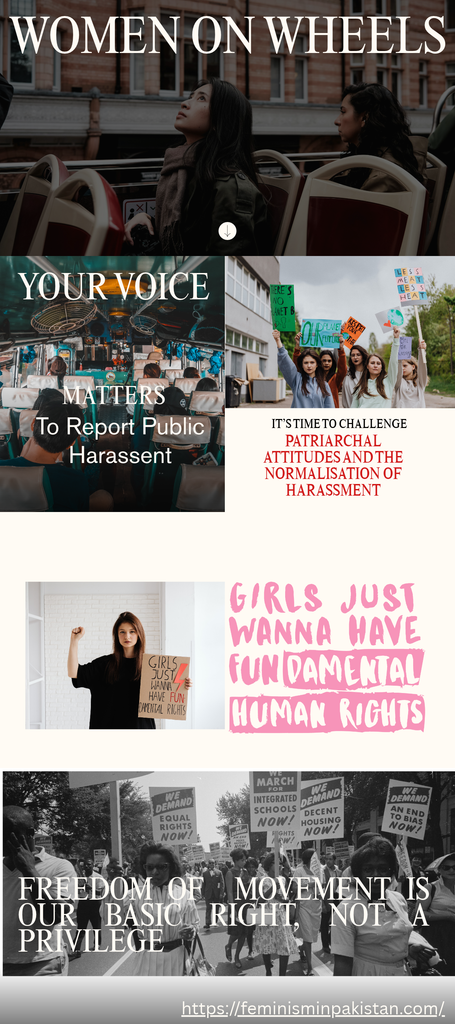
5. Freedom of Movement Is a Right of All Women, Not a Privilege
Women’s freedom of movement is closely connected to their access to education, economic independence and participation in society. When women feel unsafe while travelling, they may face barriers to reaching universities, workplaces and essential services. These restrictions affect individual lives and can also limit the country’s wider social and economic development.
Women should not have to give up opportunities because public spaces are unsafe. Responsibility for preventing and addressing harassment rests with perpetrators and with the institutions responsible for public safety—not with the women who experience it. A woman’s right to move freely should not depend on having a man accompany her or on making alternative transport arrangements. A safe city is one in which women can reach their destinations, participate in public life and move with dignity, independence and freedom from fear.
About the Author
Esha Afzal is an MPhil student at Forman Christian College (A Chartered University), Lahore, with academic interests in gender studies, women’s rights, and women’s political participation in Pakistan. Her writing explores gender equality, women’s lived experiences, and contemporary social issues, contributing to discussions on feminism and social change in Pakistan.